
Modi's comments on underlining the importance of ensuring the safety of seafarers came against the backdrop of growing anger in India over the killing of the three Indian crew members in a US military attack on a merchant ship off the coast of Oman last week.

Global oil prices fell on Thursday to their lowest levels since before the outbreak of the Iran conflict, offering a significant economic tailwind for India, the world's third-largest crude importer, by easing inflation risks, reducing the import bill and improving the government's fiscal position.

Sharp compression in imports and declining exports has narrowed the country's trade deficit to 15-month low of $10.3 billion in June.

India's merchandise exports in May rose by 20.55 per cent to USD 38.94 billion, while the trade deficit ballooned to a record USD 24.29 billion, according to government data released on Wednesday.

The rising dependence on discounted crude oil has resulted in India's trade deficit with Russia hitting the second-highest place last year, after China, reveals Department of Commerce data. From April through January 2022-23 (FY23), India's maximum trade deficit was with China, at $71.58 billion. This was followed by Russia, where the deficit expanded sevenfold - from $4.86 billion in April-January of 2021-22 (FY22) to $34.79 billion during the same period in FY23.

The trade deficit with China continues to soar at a blistering pace even as India is looking at aggressively increasing and strategising the reach of its products into the Chinese markets.

Sensex and Nifty post steepest weekly loss in over a year, falling nearly 3 per cent.

The Indian rupee is highly vulnerable among Asian currencies, with Barclays and MUFG warning of a potential depreciation towards 100/$ if the West Asia conflict persists, driven by widening current account deficits and elevated crude oil prices.

A more effective promotion of domestic manufacturing and mining could significantly reduce the trade deficit in key sectors, says T N Ninan.

'The situation globally is quite challenging, but we have the confidence and courage of conviction that we will come out winners even in this challenging time.'

These new tariffs were imposed by Trump on all countries, including India, on February 24 for 150 days following a Supreme Court verdict that struck down his earlier sweeping levies.

The Indian stock market mythos of 36 years is wrapped in a diaphanous negligee, lashed together by a delicate, etheric sash of 1.6 bull markets. To make money from here on will require a ground invasion, trench by trench, rather than carpet bombing. Way more difficult, points out Shankar Sharma.

Exports rise for 8th month, albeit at lower pace

The US said India will lower tariffs on a "vast array" of American industrial and agricultural goods, such as "fruits, vegetables", to zero per cent under the trade deal announced by President Donald Trump.

The global artificial intelligence (AI) boom has significantly reshaped equity markets, with Taiwan surpassing India to become the world's fifth-largest stock market. India has seen its market capitalisation decline by 7% year-to-date, while AI-linked economies like Taiwan and South Korea have surged.

The Indian government is set to accelerate reforms, including measures to enhance foreign direct investment, speed up divestment, and boost asset monetisation, to maintain economic growth despite rising fuel and fertiliser import costs driven by the West Asia crisis.

Foreign Portfolio Investors (FPIs) withdrew nearly Rs 33,000 crore from Indian equities in May, bringing the total outflow for 2026 to Rs 2.25 lakh crore, driven by weak earnings growth, rupee depreciation, and more attractive opportunities in other global markets.

Sensex plunges over 1,400 points and Nifty slips near 22,250 amid Trump's Iran threat, rising crude oil prices, and FII selling. Here are the key reasons behind today's market crash.
Indian equities on Dalal Street saw volatility as global market trends and fresh tariff concerns linked to Donald Trump impacted investor sentiment. Track Sensex, Nifty50 movement and key market drivers for April 2, 2026.

Exports declined for the fourth-consecutive month by 10.3 per cent year-on-year to $34.98 billion in May, while the trade deficit widened to a five-month high of $22.12 billion. According to the data released by the commerce ministry on Thursday, key export sectors recording negative growth include petroleum products, gems and jewellery, engineering goods, ready-made garments of all textiles and chemicals. Imports also declined 6.6 per cent, six-month in a row, to $57.1 billion against $61.13 billion in the same month last year, the data showed.

S&P Global Ratings has increased India's GDP growth forecast for the next fiscal year to 7.1 per cent, citing private consumption, investment, and exports as key drivers. However, the agency also cautioned that the conflict in the Middle East could strain India's fiscal position due to higher energy prices.

A depreciating rupee, which briefly hit 80 to the dollar on Tuesday, may boost India's exports but price-inelastic imports of crude oil and gold would mean limited relief on the trade deficit, which clocked a record $26.2 billion in June. Due to global risk aversion on the back of geo-political tensions and aggressive policy tightening by the Fed, the dollar has appreciated against most currencies, including the rupee. And, with other currencies depreciating, India's comparative advantage in this respect may be limited.

During the first six months of the financial year, the country's exports dipped by 6.79 per cent to $143.6 billion from $154.1 billion in the same period last year.

Trade deficit shot up by 114.2 per cent in October, this year at $2,021.04 million as against $943.91 million in October 2002.

India emerged reasonably well from 2025. But now, the oil shock and war-related supply disruptions have again driven funds out of India and significantly weakened the rupee, points out Ajay Chhibber.

Foreign Portfolio Investors (FPIs) have withdrawn nearly Rs 43,000 crore from Indian equities in the first week of June, contributing to a total outflow of Rs 2.67 lakh crore in 2026, driven by a global shift towards technology and AI-linked opportunities and persistent rupee depreciation.

Insights from behavioural economics suggest that an ambitious nudge can be effective if three conditions are met, points out Ram Singh Insights from behavioural economics suggest that an ambitious nudge can be effective if three conditions are met, points out Ram Singh, director, Delhi School of Economics.

India's current account deficit narrowed to $1.3 billion or 0.2 per cent of GDP in the January-March quarter of FY23, mainly due to moderation in the trade deficit and a robust increase in services exports, RBI data showed on Tuesday. However, for the 2022-23 fiscal, the current account balance recorded a deficit of 2 per cent of GDP compared to 1.2 per cent in 2021-22. "India's current account deficit (CAD) decreased to $1.3 billion (0.2 per cent of GDP) in Q4:2022-23 from $16.8 billion (2.0 per cent of GDP) in Q3:2022-231, and $13.4 billion (1.6 per cent of GDP) a year ago [Q4:2021-22]," as per the RBI's 'Developments in India's Balance of Payments during the Fourth Quarter (January-March) of 2022-23'.
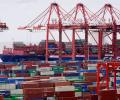
The country's exports in December 2021 surged 38.91 per cent on an annual basis to $37.81 billion due to healthy performance by sectors such as engineering, textiles and chemicals, even as the trade deficit widened to $21.68 billion during the month, government data showed on Friday. Imports in December 2021 too increased 38.55 per cent to $59.48 billion. During April-December 2021-22, exports rose 49.66 per cent to $301.38 billion.

The trade deficit stood at $10.14 billion compared with $9.22 billion in November, a trade ministry official said on Friday.
India's exports rose by 2.14 per cent to $36.27 billion in July while the trade deficit almost tripled to $30 billion during the month due to over 70 per cent rise in crude oil imports, according to official data released on Friday. Imports shot up by 43.61 per cent to $66.27 billion in the month compared to July 2021, the data showed. The trade deficit was $10.63 billion in July 2021.

The Indian rupee, swaying through multiple headwinds, tiding over global trade disruptions and massive foreign fund outlfows, is unlikely to arrest its descent until tariff impact overhangs, notwithstanding robust domestic macroeconomic tailwinds. The Reserve Bank of India (RBI), which sees the rupee's depreciation as a silver bullet to offset the tariff shock, expects the currency to find its stable course once India reaches a trade deal with its largest trading partner, the US.
The country's exports rose by 48.34 per cent to $32.5 billion on account of healthy growth in shipments of petroleum products, gems and jewellery, and chemicals, leather and marine goods, according to the data released by the Commerce Ministry on Thursday. Imports in June too rose by 98.31 per cent to $41.87 billion, leaving a trade deficit of $9.37 billion as against a trade surplus of $0.79 billion in the same month last year. During April-June 2021, the exports increased by 85.88 per cent to $95.39 billion.
India's exports in January dipped by 6.58 per cent to $32.91 billion, as against $35.23 billion in the same month last year, according to the data released by the commerce ministry on Wednesday. Trade deficit in January stood at $17.75 billion.
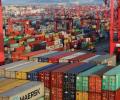
September import growth was the second lowest this fiscal year, after the April growth figures of 4.6 per cent, bringing the trade deficit down to $13.98 billion
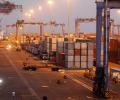
After recording positive growth for two months in a row, India's exports dipped marginally by 0.25 per cent to $27.67 billion in February and trade deficit widened to $12.88 billion, according to preliminary data released by the government on Tuesday. Imports grew 6.98 per cent to $40.55 billion during the month, the data showed. The trade deficit stood at $10.16 billion in February 2020. Exports during April-February 2020-21 were $255.92 billion, compared with $291.87 billion during the same period of last year, exhibiting a negative growth of 12.32 per cent.

'Even last year, when India bought gold, the physical quantity was much less than the previous years.'

Foreign Portfolio Investors (FPIs) have withdrawn Rs 27,048 crore from Indian equities so far in May, bringing the total outflows for 2026 to Rs 2.2 lakh crore, driven by global macroeconomic and geopolitical uncertainties.

Mirra Andreeva announced herself as the latest member of women's tennis's elite on Saturday, defeating surprise finalist Maja Chwalinska to become the youngest French Open champion in more than three decades.
Exports of goods during August rose 27 per cent to $ 16 billion, from $ 12.61 billion in the same month last year. Imports rose sharply by over 51 per cent at $ 29.94 billion due to the increase in the value of crude oil imports. The government is worried about the rising trade deficit. "It is a cause of concern. But the fundamentals of the economy are strong and we will be able to absorb it," said a commerce ministry official.
